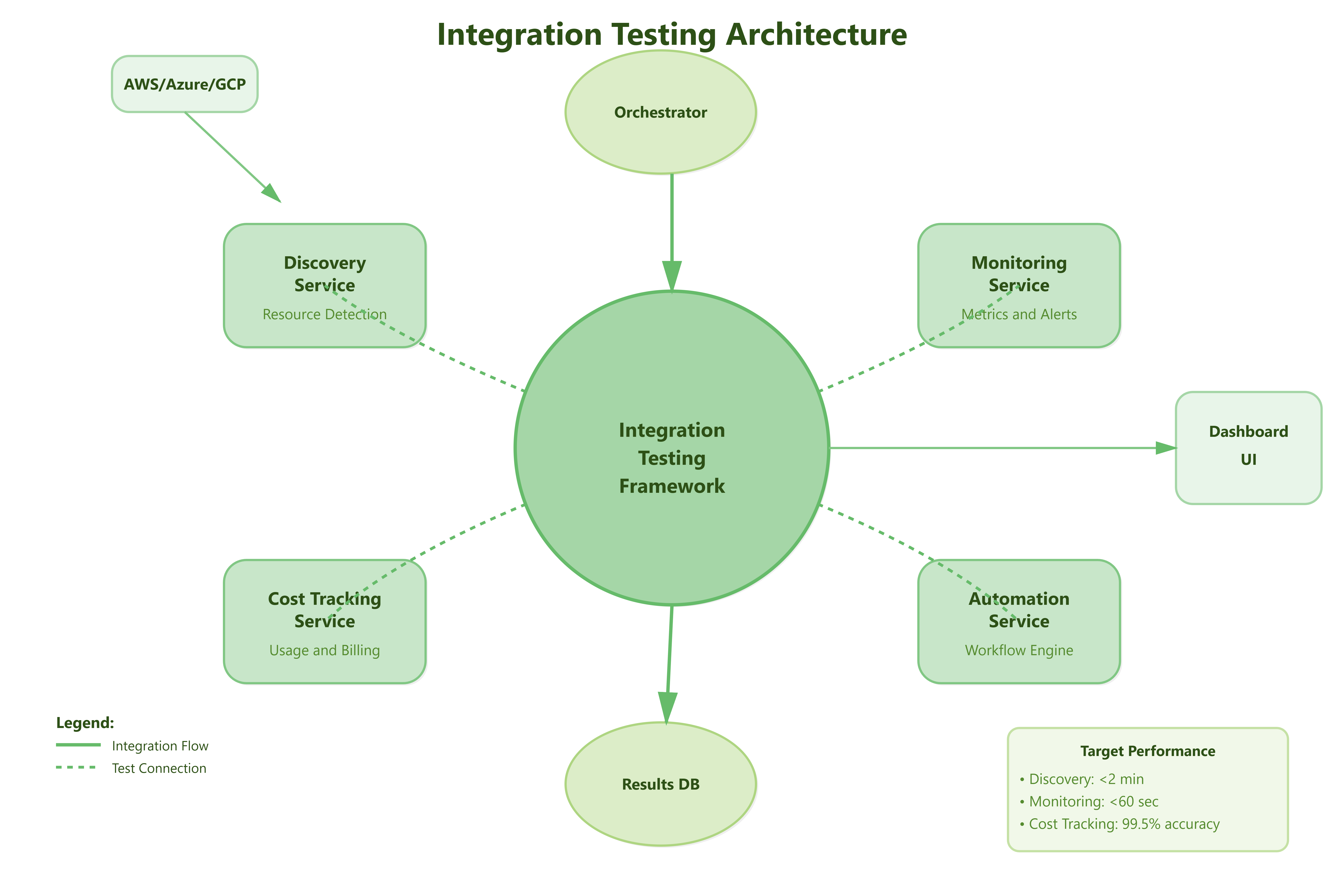
Day 91: Infrastructure Integration Testing - Testing the Complete System
What We’re Building Today
Today we integrate and test everything we’ve built over the past weeks: monitoring systems, resource discovery, cloud integrations, cost tracking, and infrastructure automation. Think of this as Netflix’s pre-deployment validation that tests 200,000+ instances before a single production change, or Datadog’s integration testing that validates 500+ million metrics per minute across customer infrastructures.
We’ll build a comprehensive integration testing framework that:
Validates complete infrastructure monitoring pipelines
Tests automated resource discovery across AWS, Azure, and GCP
Verifies cloud API integrations with real provider endpoints
Validates cost tracking accuracy against actual billing data
Tests infrastructure automation workflows end-to-end
Real-World Impact: Stripe’s infrastructure integration testing catches billing discrepancies that prevent $100M+ annual cost overruns. GitHub’s automated testing validates infrastructure changes across 15,000+ compute instances before deployment.
The Integration Testing Challenge
When Airbnb scaled to manage 50,000+ cloud resources across multiple providers, their biggest challenge wasn’t individual component failures—it was ensuring all systems worked together correctly. A monitoring alert that fires correctly but fails to trigger the cost optimization workflow creates silent failures that cost millions annually.
Traditional unit tests validate individual components, but integration testing validates the entire system workflow: resource discovery → monitoring → alerting → cost tracking → automation → reporting. Each component might work perfectly in isolation but fail when real data flows through the complete pipeline.