Day 57: Export System Foundation
Building Production-Grade Data Export with Multi-Format Support
What We’re Building Today
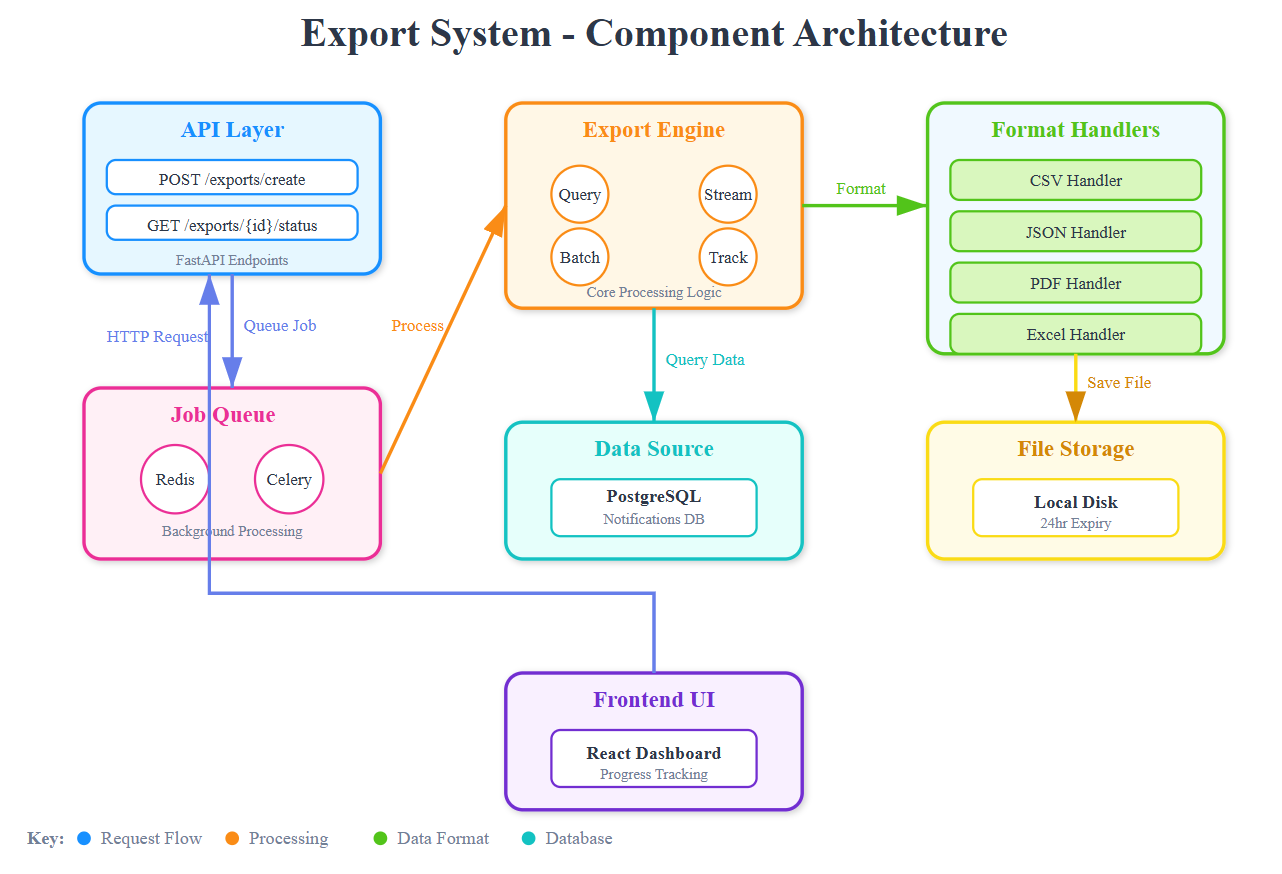
Today we’re implementing a multi-format export system that transforms notification data into CSV, JSON, PDF, and Excel formats. You’ll build streaming export pipelines that handle millions of records without crashing, implement asynchronous job processing, and create a dashboard for download management. This is the same architecture Slack uses for workspace exports and GitHub uses for repository archives.
High-Level Goals:
Multi-format export engine (CSV, JSON, PDF, Excel)
Streaming data pipeline for large datasets
Async job queue with progress tracking
Download management dashboard
Background worker processing
Why Export Systems Matter in Production
When Slack generates a workspace export with 5 million messages, they don’t load everything into memory. When GitHub creates a repository archive, they stream files incrementally. Export systems are critical infrastructure that handle data serialization at scale while managing memory, processing time, and user experience.
Real-World Impact:
Slack: Processes 100,000+ workspace exports daily, each containing years of messages
Stripe: Generates financial reports with millions of transactions in multiple formats
Salesforce: Handles customer data exports with strict compliance requirements
Jira: Creates project reports combining issues, comments, and attachments
The challenge isn’t just format conversion—it’s doing it efficiently without consuming all server resources or making users wait hours.
Component Architecture