Day 134: Test Strategy Enhancement
What We Build Today
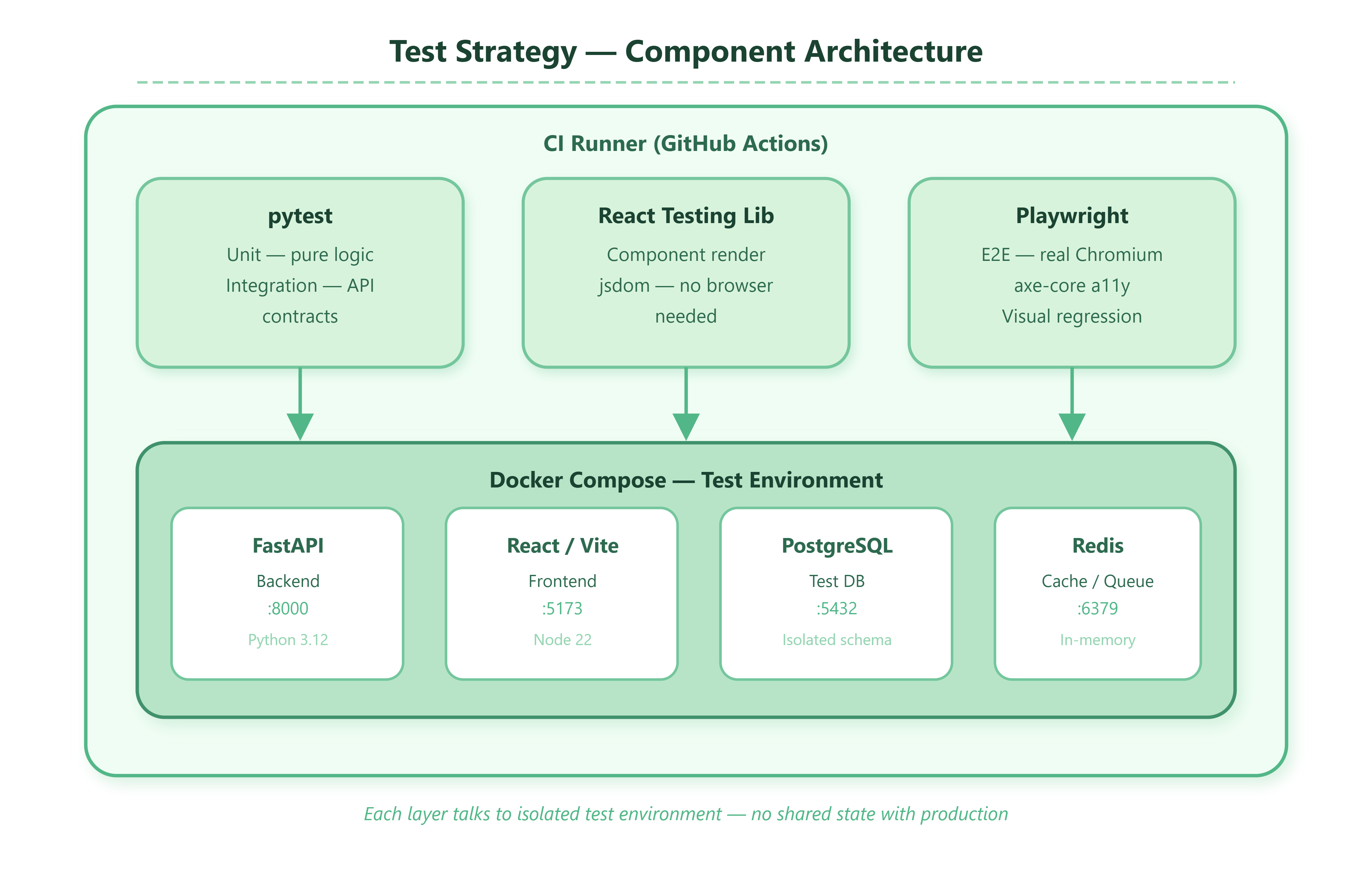
# Layer Tools 1 Unit test suite pytest · React Testing Library 2 Integration test suite FastAPI TestClient · real PostgreSQL 3 End-to-end test suite Playwright · Chromium 4 Visual regression Playwright screenshots · pixel diff 5 Accessibility audit axe-core injected into every E2E run
Why a Testing Pyramid — and Why It Matters at Scale
Google, Netflix, and Shopify all operate on the same principle: the cost of a bug multiplies with how late you catch it. A unit test that runs in 5 ms catches logic errors in milliseconds. A production incident takes hours of engineering time and burns user trust that is very hard to earn back.
The classic Testing Pyramid — many unit tests, fewer integration tests, fewest E2E tests — is not academic doctrine; it is a throughput constraint. If 80% of your coverage lives in fast unit tests, your CI pipeline finishes in 3 minutes. Invert the pyramid and every pull request blocks for 45 minutes.
              /\
             /E2\           few · slow · high-confidence
            /----\
           / Int. \         moderate · sits at the API boundary
          /--------\
         /  Unit   \        many · fast · pure logic
        /------------\