

Day 121: API Rate Limiting
What We’re Building Today
By the end of this lesson you will have a production-grade API Rate Limiting system wired into your infrastructure management platform. Here is the agenda:
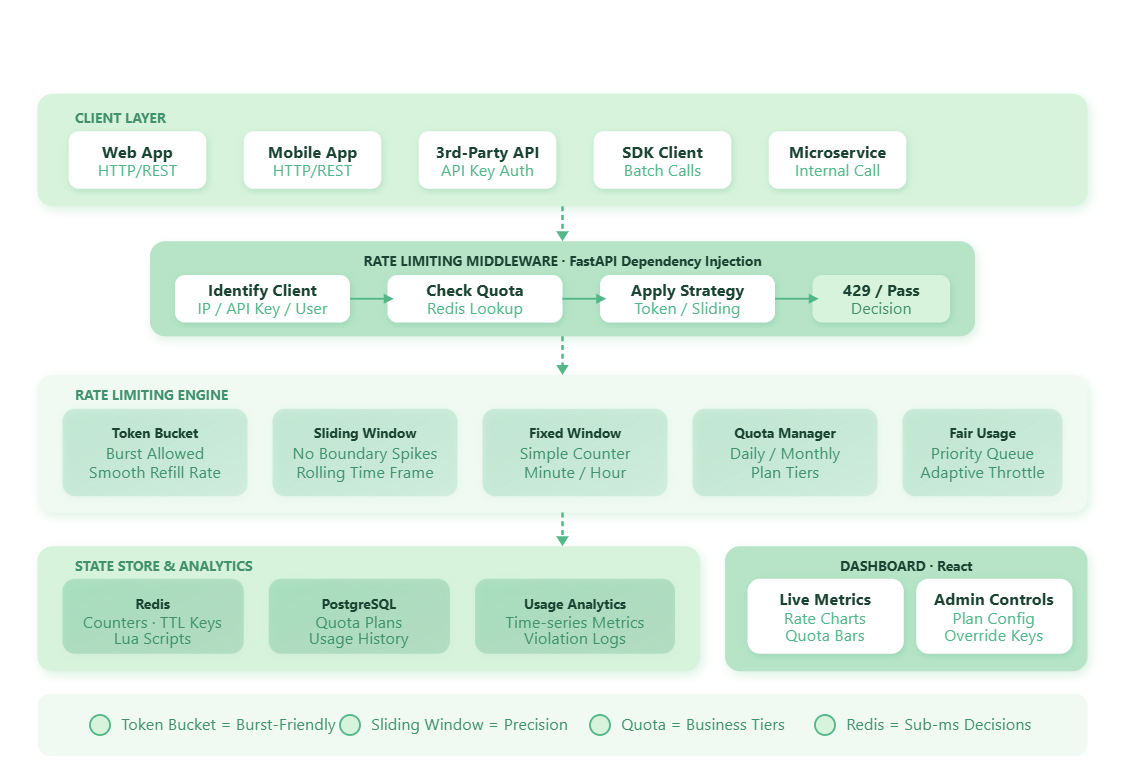
Token bucket & sliding window algorithms — implemented atomically in Redis
Quota management — per-user, per-plan daily/monthly caps
Throttling strategies — adaptive backoff with
Retry-AfterheadersUsage analytics — real-time call tracking and violation logging
Fair usage policies — priority tiers so premium users never get squeezed by free-tier noise
React dashboard — live rate charts, quota gauges, plan management, and admin overrides
Prerequisites: Python 3.12+, Node.js 18+, Docker & Docker Compose, Redis 7.x, PostgreSQL 16, Day 120 completed.
Why Rate Limiting Is Not Optional
Stripe serves 500 million API calls per day. GitHub CI triggers 100 million webhook events per hour. Without rate limiting, a single misbehaving client — or a genuine traffic spike — can cascade into a database brownout that impacts every other tenant.
Rate limiting is the circuit breaker at the API boundary. It protects three things simultaneously: your infrastructure from overload, your paying customers from noisy neighbours, and your business from compute bills that spiral out of control.
Where This Fits in the System
Rate limiting sits between your API gateway and your route handlers. Every request passes through it before touching business logic — it is the toll booth before the highway. The middleware intercepts, identifies the caller, makes a sub-millisecond Redis decision, and either forwards the request or returns a structured 429 with retry guidance.
The key architectural insight here is that two separate systems protect you:
Rate limiting — requests-per-second smoothing, decided entirely in Redis, sub-millisecond
Quota management — daily/monthly contract limits, backed by PostgreSQL and cached in Redis
This separation means bursting 10 requests in one second does not consume your monthly quota 10× faster than normal. They govern entirely different dimensions of access.
Preparing for a distributed systems interview?
→Download the free Interview Pack
→ Subscribe now to access source code repository - 200 + coding lessons
