
Day 115: Database Optimization
What We’re Building Today
By the end of this lesson you will have a production-grade database optimization layer running inside your infrastructure management platform. Here is what we will wire up from start to finish:
A query analysis engine that reads
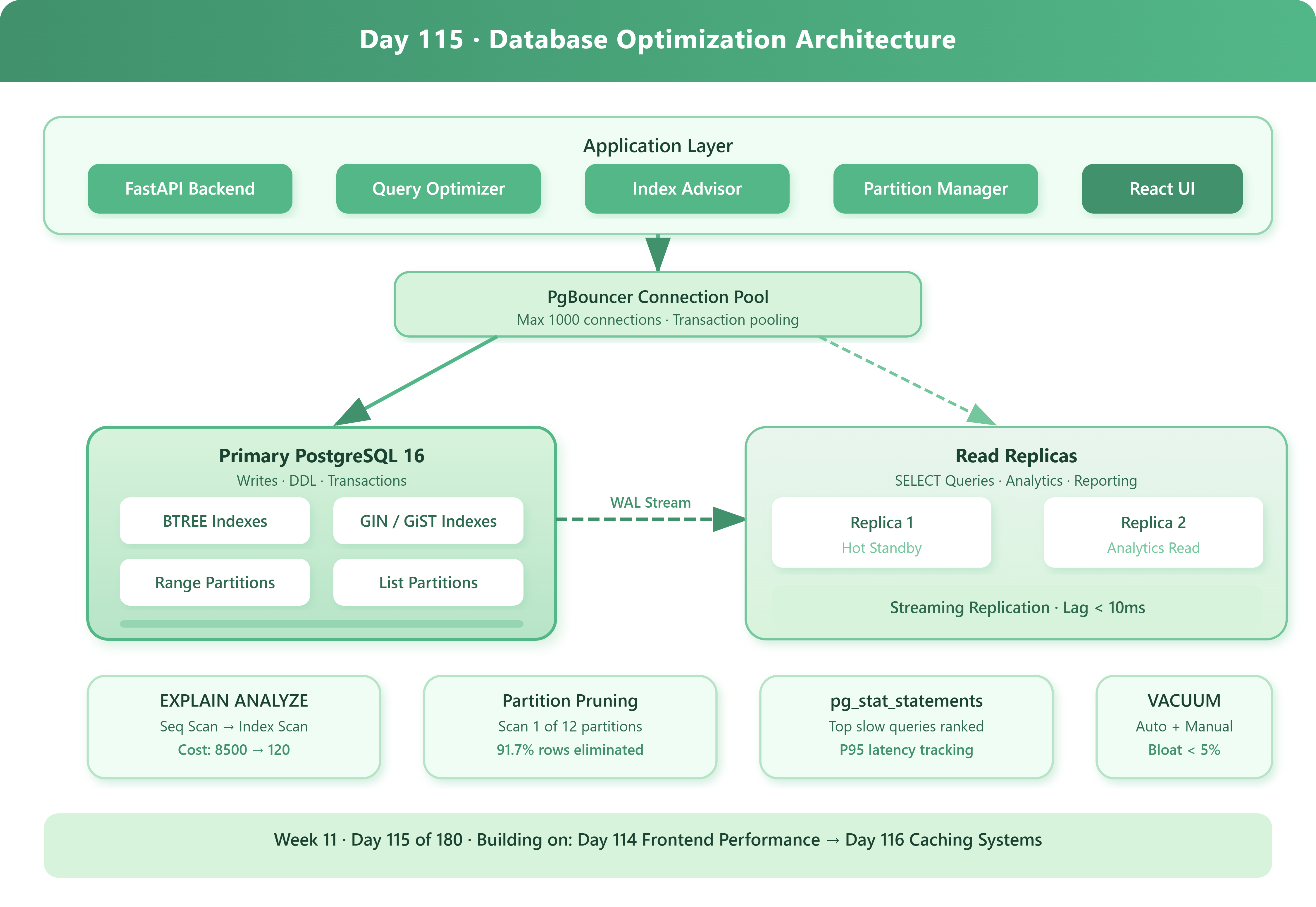
EXPLAIN ANALYZEoutput programmatically and surfaces slow queries in real time. An index advisor that detects missing indexes and creates them safely withCONCURRENTLY. Partitioned tables — we will range-partition a high-volume events table by month and watch the planner skip 91% of partitions automatically. Read replica routing that sends allSELECTtraffic to a hot-standby replica and measures replication lag at the millisecond level. Storage hygiene through scheduledVACUUM, bloat tracking, and keeping table health above 95%. And finally, a live UI dashboard — a Datadog-style database health panel with query latency, index hit rate, and replica lag gauges, all updating every five seconds.
Before You Start — Prerequisites
Make sure you have these installed and ready before running a single command:
Docker Desktop 24 or newer (required for the replica mode). PostgreSQL 16 client tools — on macOS run brew install postgresql@16, on Ubuntu run apt install postgresql-client-16. Node 20 or newer, and Python 3.11 or newer. The following ports must be free on your machine: 3000, 5432, 5433, 6432, and 8000.
Why This Matters in Production
Every engineering team hits this wall at some point. The application code is clean, the server has plenty of RAM, and yet page load times balloon to three or four seconds. Nine times out of ten the culprit is the database — a single sequential scan on a table that quietly grew to 50 million rows overnight.
Netflix’s data engineering team documented exactly this scenario: switching from sequential scans to composite indexes on their viewing history table cut query latency from 4,200 ms down to 38 ms. That is not a minor tweak — it is the difference between users staying on the platform and users closing the tab.
Preparing for a distributed systems interview?
→Download the free Interview Pack
→ Subscribe now to access source code repository - 200 + coding lessons
