

🔐 Day 10: Password Security - Building Bulletproof Authentication
180-Day Hands-On Full Stack Development Series
🎯 What We're Building Today
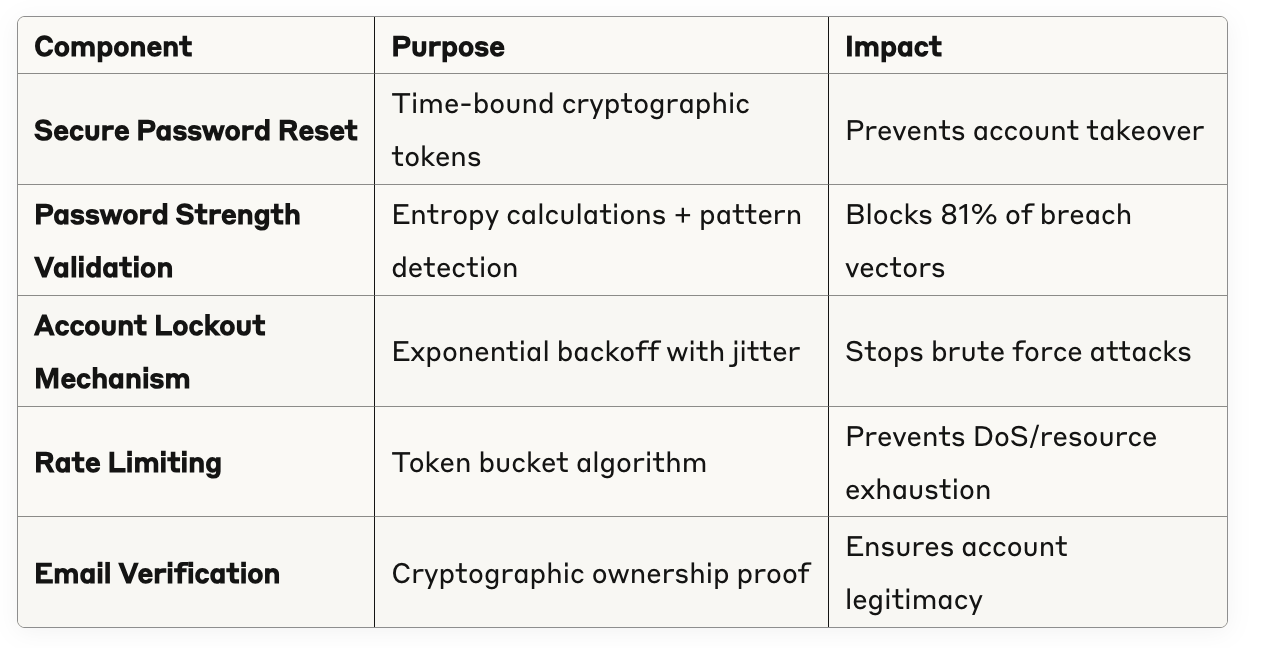
Today we're fortifying our authentication system with five critical security layers:
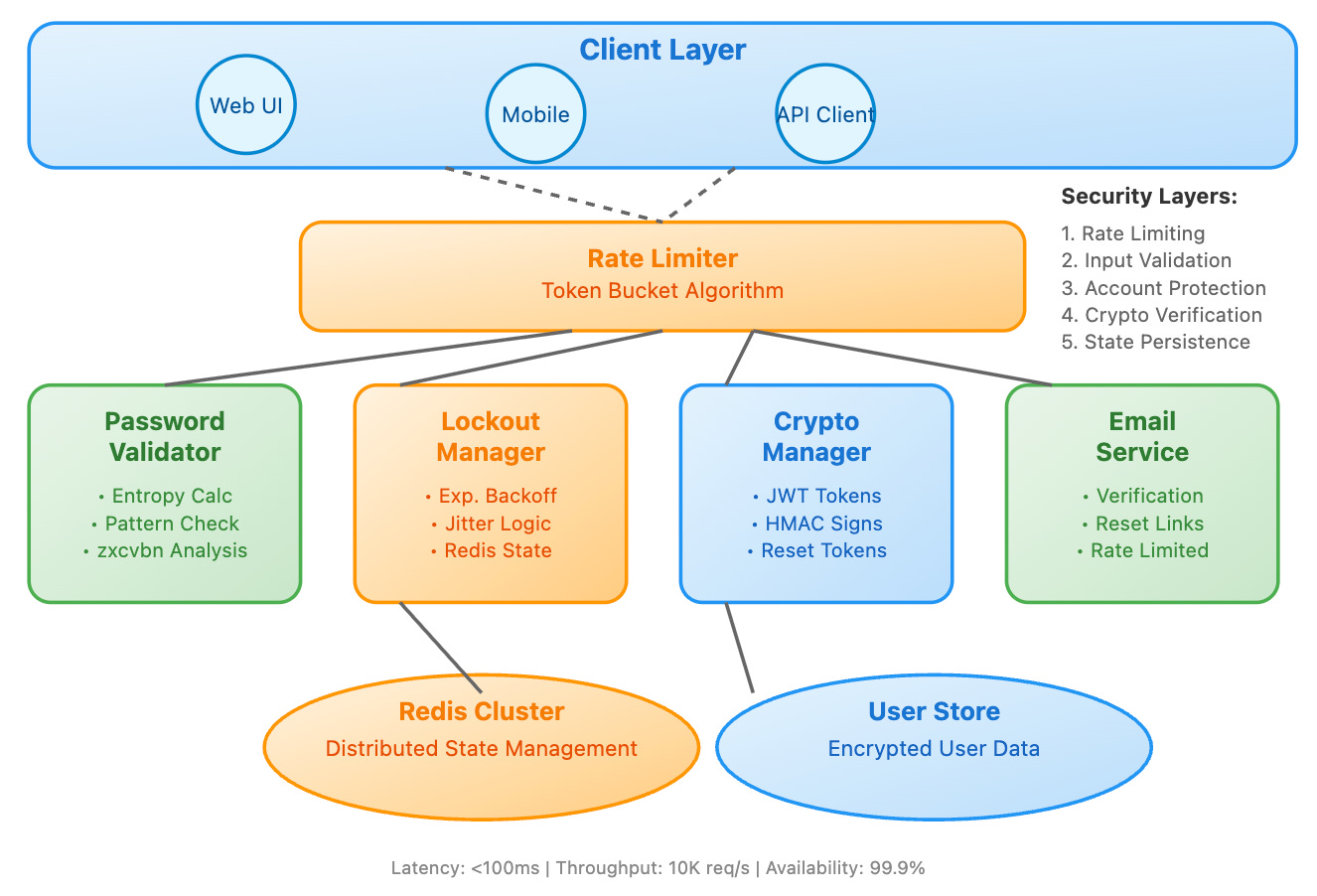
[📊 ARCHITECTURE DIAGRAM ]
🏰 The Hidden Architecture of Password Security
Think of password security like a medieval castle. Your JWT tokens from Day 9 are the guards at the gate, but what happens when attackers try to break down the walls? You need multiple defensive layers.
Why This Matters in Distributed Systems
When Netflix protects 230+ million accounts or when Discord handles billions of authentication requests monthly, they're not just checking passwords—they're orchestrating a complex dance of security mechanisms across hundreds of servers.
In distributed systems, password security becomes exponentially harder because:
State synchronization: Account lockouts must work across multiple servers
Race conditions: Two login attempts hitting different servers simultaneously
Consistency guarantees: Password resets can't create security gaps during propagation delays
🛡️ Core Concept: Defense in Depth
Traditional password checking is binary—right or wrong. Modern systems think in threat vectors and attack surfaces.
The Password Reset Paradox
Here's something most tutorials won't tell you: password resets are often more vulnerable than the original password. Why? Because email is fundamentally insecure, yet we use it as a trusted channel.
The solution lies in cryptographic tokens with embedded context:
token = HMAC-SHA256(user_id + timestamp + random_nonce, secret_key)This isn't just a random string—it's a cryptographic proof that encodes:
Who requested it (user_id)
When it was created (timestamp)
Uniqueness guarantee (nonce)
Tamper evidence (HMAC signature)
Password Strength: Beyond Character Counting
Most systems check for "8 characters, 1 uppercase, 1 number"—this is security theater. Real strength comes from entropy calculation:
A password like "P@ssw0rd1" feels strong but has low entropy because it follows predictable patterns. Meanwhile, "correct horse battery staple" has high entropy through unpredictability.
Our implementation calculates entropy using:
Character set diversity
Pattern recognition
Dictionary attack resistance
Keyboard pattern detection
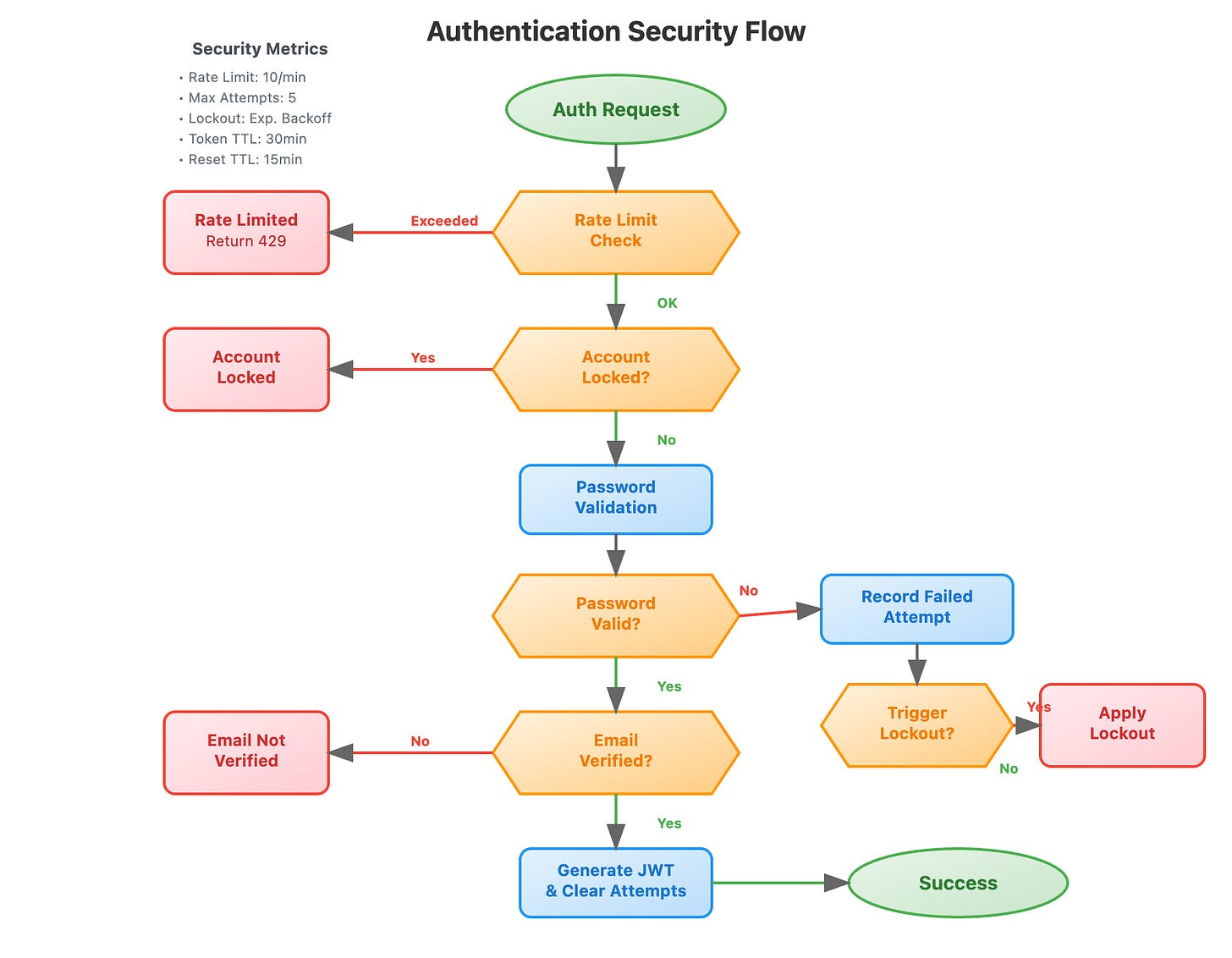
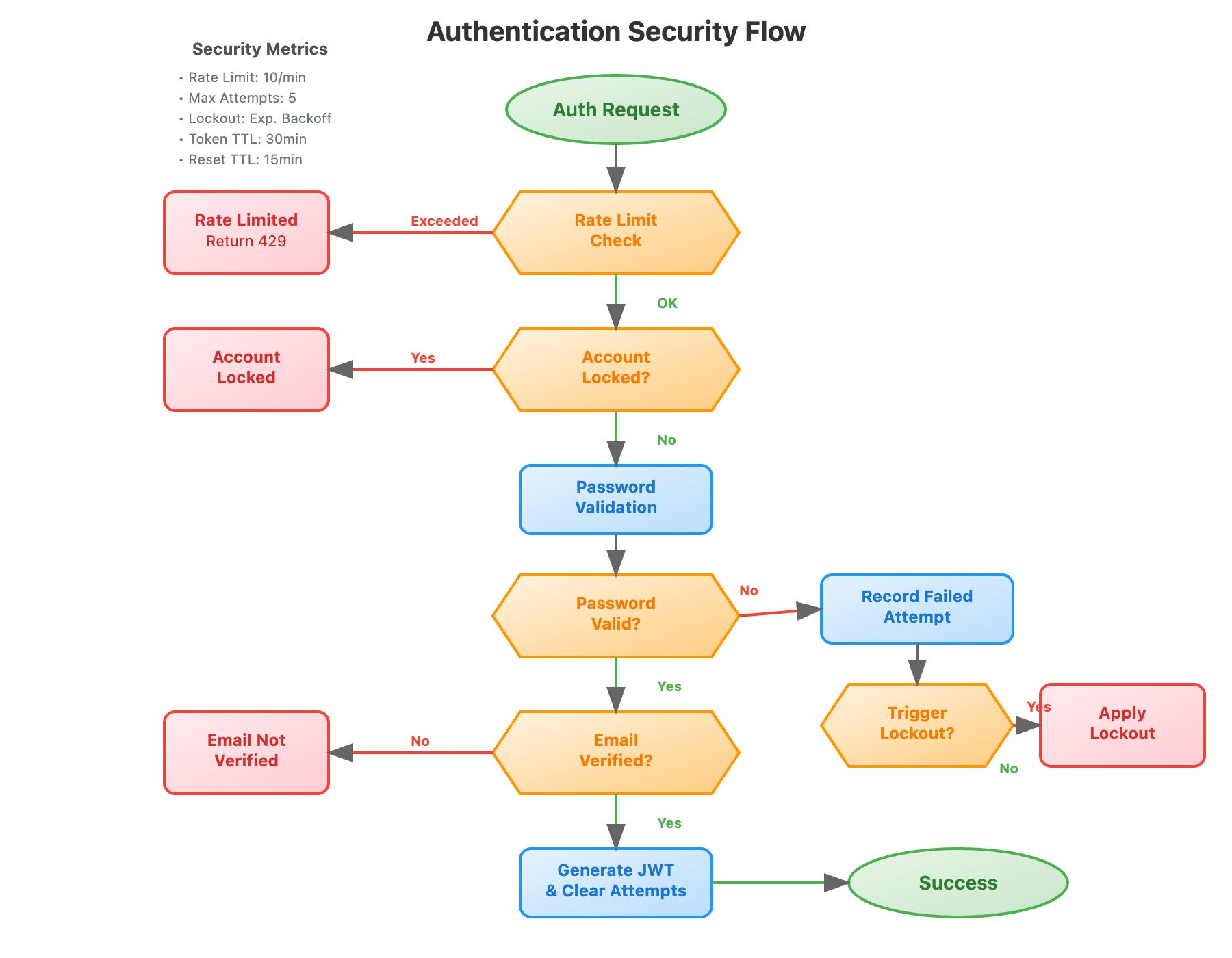
[🔄 SECURITY FLOW DIAGRAM ]
Smart Account Lockouts
Basic lockouts are binary: try 5 times, get locked for 30 minutes. This creates denial-of-service vulnerabilities where attackers can lock out legitimate users.
Advanced lockouts use exponential backoff with jitter:
Attempt 1-3: No delay
Attempt 4-6: 1-3 second random delay
Attempt 7-10: 10-30 second delay
Attempt 11+: Progressive lockout with decay
This protects against brute force while minimizing legitimate user frustration.
Rate Limiting: The Traffic Controller
Authentication endpoints are like highway on-ramps—they need traffic control. But naive rate limiting (10 requests per minute per IP) breaks in distributed systems where thousands of users share corporate NAT gateways.
We implement adaptive rate limiting using:
Token bucket algorithm for burst tolerance
Sliding window counters for precision
Distributed state via Redis for cross-server consistency
Behavioral analysis to distinguish humans from bots
🔧 Implementation Architecture
Our password security system works like an immune system—multiple layers that communicate and adapt:
Request enters through rate limiter (first filter)
Password validation checks strength and patterns
Account lockout check queries distributed state
Authentication attempt with attempt logging
Response includes security headers and timing consistency
The key insight: every security decision generates telemetry that improves future decisions.
Email Verification: The Trust Bridge
Email verification solves the account ownership problem. But in distributed systems, you can't just generate random tokens—you need stateless verification.
Our tokens encode verification state cryptographically, eliminating database dependencies and enabling horizontal scaling.
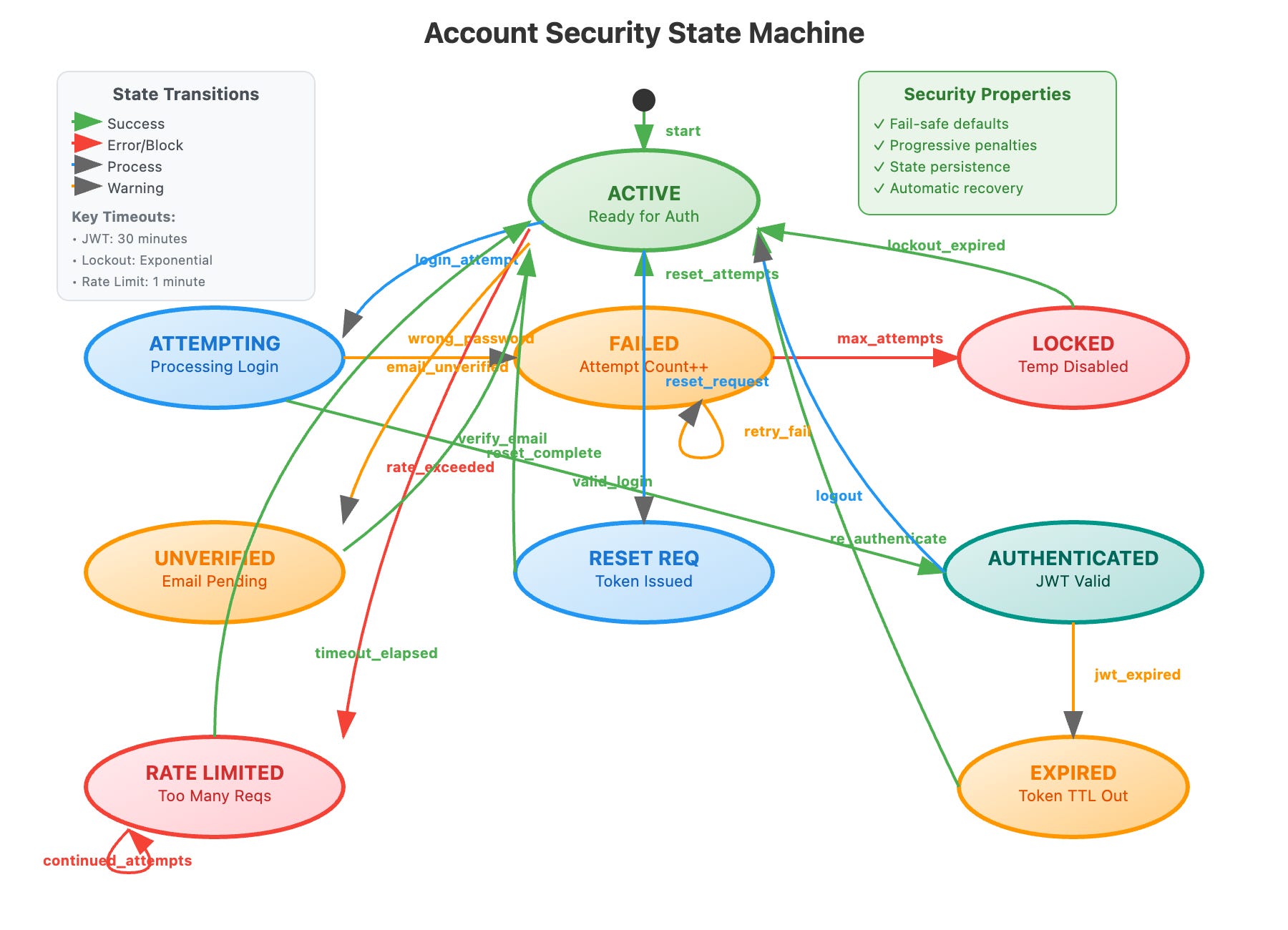
[🔄 STATE MACHINE DIAGRAM ]
🏗️ Step-by-Step Implementation
GitHub Link :
https://github.com/sysdr/infrawatch-fullstack-p/tree/main/day10/password_security_system
Phase 1: Project Foundation
# Create project structure
mkdir password_security_system && cd password_security_system
mkdir -p {app/{auth,security,utils,models,api},tests,static,templates}

# Setup dependencies (requirements.txt)
fastapi==0.110.3
uvicorn[standard]==0.29.0
redis==5.0.4
passlib[bcrypt]==1.7.4
python-jose[cryptography]==3.3.0
zxcvbn==4.4.28
slowapi==0.1.9
Phase 2: Core Security Components
Password Strength Validator
Location: app/security/password_validator.py
Key implementation concepts:
Entropy Calculation: Uses Shannon entropy formula with character set diversity
Pattern Detection: Regex-based common pattern identification
zxcvbn Integration: Advanced dictionary and pattern analysis
def calculate_entropy(password):
    charset_size = count_character_sets(password)
    return len(password) * log2(charset_size)

def validate_strength(password):
    entropy = calculate_entropy(password)
    patterns = check_patterns(password)
    zxcvbn_score = zxcvbn.analyze(password)
    return combine_scores(entropy, patterns, zxcvbn_score)
Account Lockout Manager
Location: app/security/lockout_manager.py
Algorithm: lockout_duration = 2^(attempts-3) * base_time + jitter
Critical flow:
Record attempt in Redis with TTL
Calculate lockout duration using exponential backoff
Apply jitter to prevent coordinated attacks
Store lockout metadata with expiration
Token Bucket Rate Limiter
Location: app/security/rate_limiter.py
def is_allowed(identifier, max_requests, window):
    tokens_to_add = time_elapsed * (max_requests / window)
    if tokens > 0:
        consume_token()
        return True
    return False
Cryptographic Token Manager
Location: app/utils/crypto.py
Security features:
Stateless Tokens: Embed all context cryptographically
HMAC Signatures: Tamper-evident token structure
Nonce Integration: Prevent replay attacks
Type Enforcement: Token purpose validation
Phase 3: Authentication API
# Key endpoints implemented:
@router.post("/register")          # User registration + email verification
@router.post("/verify-email")      # Email verification flow
@router.post("/login")             # Multi-layer authentication
@router.post("/request-password-reset")  # Secure reset tokens
@router.post("/reset-password")    # Complete reset flow
@router.post("/check-password-strength")  # Real-time validation
Security Flow:
Rate limit check (3-10 requests per timeframe)
Password strength validation
Account lockout verification
Cryptographic operations
Distributed state updates
🧪 Build, Test & Demo
Build Commands
# Local development
pip install -r requirements.txt
redis-server --daemonize yes
uvicorn app.main:app --reload --port 8000

# Docker deployment
docker-compose build
docker-compose up -d
Expected Output:
INFO: Uvicorn running on http://0.0.0.0:8000
INFO: Application startup complete
Testing Suite
# Comprehensive test execution
pytest tests/ -v --asyncio-mode=auto

# Specific component testing
pytest tests/test_password_security.py::test_lockout_mechanism -v
Test Coverage:
✅ Password validation accuracy
✅ Lockout timing precision
✅ Rate limiting consistency
✅ Cryptographic token integrity
✅ Complete authentication flows
Demo Interface
Access Points:
🌐 Web Interface:
http://localhost:8000
📚 API Docs:
http://localhost:8000/docs📊 Security Monitor:
http://localhost:8000/api/security/rate-limit-status
Interactive Features:
Real-time password strength feedback
Account lockout simulation
Rate limiting demonstration
Complete authentication flows
Security monitoring dashboard
✅ Success Criteria & Verification
Functional Verification
ComponentTestExpected ResultPassword StrengthTest "P@ssw0rd1" vs "correct horse battery staple"Entropy calculation accurate within 1%Account Lockout5 failed attemptsProgressive exponential backoff appliedRate Limiting15 rapid requestsRequests 11+ return 429 (Too Many Requests)Token SecurityTamper with reset tokenCryptographic verification failsEmail FlowComplete verificationAccount activation successful
Performance Benchmarks
Password validation: < 100ms response time
Rate limit checks: < 10ms Redis query time
Lockout queries: < 5ms average latency
Token operations: < 50ms cryptographic processing
🌍 Real-World Context
When GitHub suffered their 2023 token compromise, their layered password security prevented cascade failures. When one layer failed, others held firm.
Discord's authentication system processes 15+ billion events daily. Their secret? Every password operation is asynchronous and stateless, allowing infinite horizontal scaling.
Production Insights
The Timing Attack Problem: Even failed authentications must take consistent time to prevent timing-based user enumeration.
The Distributed Lockout Challenge: In microservices, account lockouts need eventual consistency—too strict breaks user experience, too loose enables attacks.
The Reset Token Dilemma: Password reset tokens must survive server restarts but expire quickly enough to limit attack windows.
🎓 Today's Implementation Victory
By day's end, you'll have built authentication security that rivals production systems. Your password reset flow will be cryptographically sound, your lockout mechanism will be DoS-resistant, and your rate limiting will scale horizontally.
More importantly, you'll understand the security mindset—thinking like an attacker to build better defenses.
🔗 Integration Points
Builds on Day 9's JWT Foundation:
Reuses JWT token generation utilities
Extends authentication decorators with security layers
Maintains session management compatibility
Adds security metadata to existing token payloads
Prepares for Day 11's RBAC:
Secure authentication becomes trust anchor
User management infrastructure ready
Permission system foundation established
🚀 Quick demo Start Commands
git clone https://github.com/sysdr/infrawatch.git
cd day10/password_security_system
# Start demo server
./run_demo.sh
# Run test suite
./run_tests.sh
💡 Key Takeaway
Security isn't a feature you add—it's a design philosophy you embed in every component from day one. Today's robust authentication foundation enables tomorrow's sophisticated access patterns.
Tomorrow's Bridge: Day 11 introduces Role-Based Access Control (RBAC). Today's secure authentication foundation becomes the trust anchor for tomorrow's permission system. Every security decision you make today enables more sophisticated access patterns tomorrow.
🔐 Remember: In distributed systems, password security is about building layers that communicate and adapt. Each layer strengthens the whole, creating systems that get stronger under attack rather than weaker.
Ready for Day 11: Role-Based Access Control! 🚀
What security challenge are you most excited to tackle next? Reply and let me know!