

Stop building another to-do app. Build the system that moves the money.
Most “full-stack” tutorials teach you to build a to-do list, a blog, or a Reddit clone — CRUD wrapped in a nice UI. Useful for learning syntax. Useless for learning what actually separates a junior engineer from someone who gets hired at Stripe, Brex, or Plaid.
PulseLedger is different. Starting now, you’ll build a real, production-shaped multi-tenant subscription billing and marketplace payouts platform — the same category of system as Stripe Billing and Stripe Connect — with three AI agents layered on top doing fraud detection, reconciliation, and natural-language financial reporting.
This isn’t a toy. By the end, you will have built, tested, and deployed a system that handles double-entry accounting, idempotent transaction processing, distributed transactions, split marketplace payouts, and agentic financial automation — the exact skill set behind the highest-paying, hardest-to-fill roles in fintech-adjacent engineering.
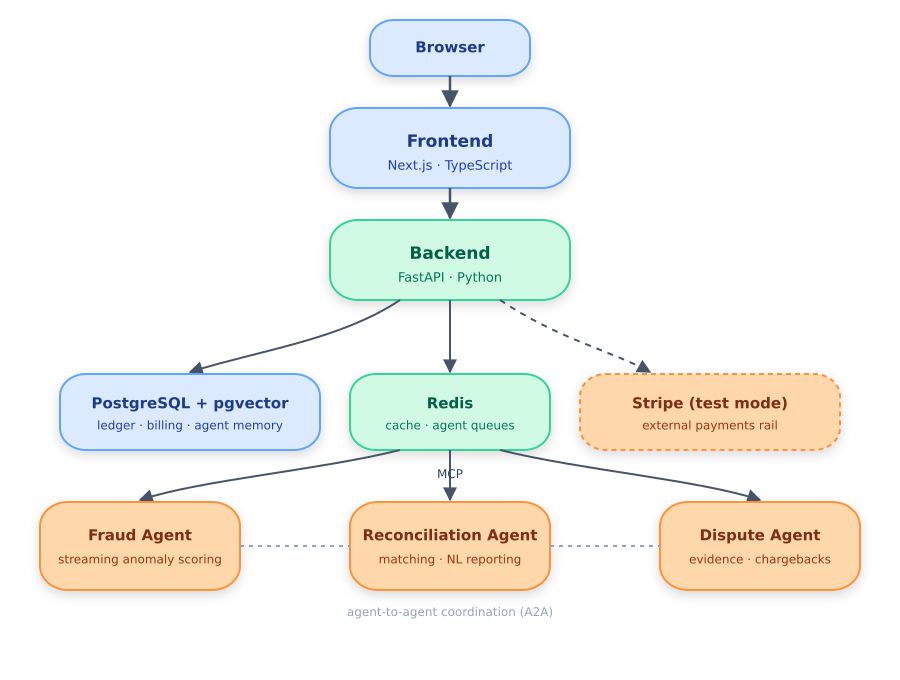
That’s the shape of what we’re building: a frontend and backend talking over a real API, a ledger and agent-memory store in Postgres, Redis dispatching work to three coordinating AI agents, and Stripe sitting at the edge as the payments rail — in test mode the entire way through, so there’s zero real financial or regulatory exposure while you learn exactly how production fintech infrastructure is actually built.
What You’ll Have Built
A multi-tenant platform with organizations, teams, and role-based access control
A subscription billing engine — plans, proration, upgrades, dunning, coupons
A real double-entry ledger — immutable, idempotent, audit-trailed, sharded by tenant
Marketplace payouts — split payments, seller onboarding, payout scheduling
Three production AI agents coordinating via MCP and A2A — fraud detection, automated reconciliation, and dispute handling
A chaos-tested, production-deployed system with a portfolio-ready capstone
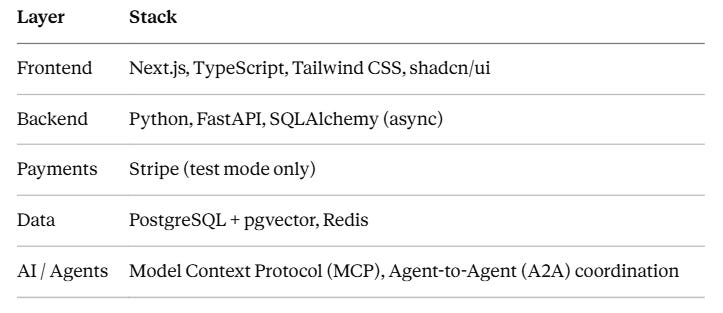
Tech Stack
How This Publishes
A new lesson drops every 2 days — enough breathing room to actually build along, not just read. Every lesson ships as: an article, an implementation guide, three architecture diagrams, and fully working source code on GitHub, building incrementally on everything before it while still standing on its own if you jump in mid-course.
Want the full module-by-module breakdown before you commit? The complete curriculum is up in a separate post — this one’s just the pitch.
Who This Is For
CS grads, software engineers, architects, product managers, QA engineers, SREs, DevOps engineers, data engineers, and technical writers — written to be accessible to a motivated high schooler while staying technically credible to a senior staff engineer. If you’ve ever wondered how Stripe actually works under the hood, or wanted to add “built a real payments platform with AI agents” to your portfolio instead of another to-do app, this is the course.
Subscribe, and the first lesson lands in your inbox on day one.